| Prep Time | Servings | Difficulty | Cost/Serving |
| 7 minutes | 1 | ⭐⭐ Intermediate | $3.00–$4.50 |
Red Gold of Persepolis: 2,500 Years of Nerve Medicine
Long before clinical trials, saffron was considered medicine. Zoroastrian healers in ancient Persia steeped crimson threads in warm milk and administered the infusion for what they called melancholy — a state we might recognize today as the overlapping clouds of pain, fatigue, and low mood that define fibromyalgia. In the ruins of Persepolis, saffron residue was found in royal ceremonial vessels dated to 500 BCE. It took 150 blossoms to yield a single gram of the spice — then as now — which is why it earned the name “red gold.”
Fast-forward to Tehran, 2016–2017. A team of researchers at Imam Khomeini Hospital ran a rigorous double-blind randomized controlled trial asking a quietly radical question: could saffron match duloxetine — an FDA-approved pharmaceutical antidepressant and the standard of care for fibromyalgia — in managing the condition’s relentless symptoms? The answer, published in the Avicenna Journal of Phytomedicine and indexed on PubMed, was yes.
In the Shakiba et al. (2018) RCT, 46 fibromyalgia patients randomized to either saffron (15 mg twice daily) or duloxetine (30 mg twice daily) for 8 weeks showed comparable improvements across the Hamilton Rating Scale for Depression (HRSD), the Fibromyalgia Impact Questionnaire (FIQ), and the Brief Pain Inventory (BPI). Saffron carried fewer side effects — no appetite suppression, fewer nausea reports — and an excellent safety profile.1
That research wave, combined with what we know about the nervous system’s nutritional vulnerabilities, is the science behind this evening ritual.
Why This Works: The Pharmacist’s Breakdown
Saffron (Crocin & Safranal) — The Mood-Nerve Dual Agent
The active constituents of saffron — crocin, crocetin, and safranal — work through multiple neuroendocrine channels simultaneously. Crocin and safranal modulate serotonin, norepinephrine, and dopamine reuptake; all three neurotransmitters are measurably reduced in fibromyalgia patients. Safranal also inhibits GABA-A reuptake, producing a gentle calming effect that mirrors low-dose benzodiazepine activity — without the dependency profile. Anti-inflammatory and antioxidant effects in the CNS add a third layer of protection against the heightened inflammatory state characteristic of fibromyalgia.1
Did You Know? It takes approximately 150 saffron flowers (Crocus sativus) — each hand-harvested at dawn — to produce just 1 gram of saffron threads. That’s why it’s the world’s most expensive spice by weight, and why even 8–10 threads in your evening mug is a pharmacologically meaningful dose.
PEA (Palmitoylethanolamide) — The Nerve Inflammation Modulator
PEA is a fatty acid amide produced naturally in the body in response to inflammation and nerve injury. Micronized PEA activates PPAR-α (peroxisome proliferator-activated receptor alpha) and interacts with cannabinoid CB2 receptors, directly reducing neuroinflammation in peripheral and central pain pathways — without psychoactivity. A landmark pooled meta-analysis by Paladini et al. (2016) covering 12 studies demonstrated that PEA produces a progressive, statistically significant reduction in pain intensity across chronic and neuropathic pain conditions, with no serious adverse events reported in any study.2
Why does it matter for fibromyalgia specifically? Fibro’s hallmark is central sensitization — the nervous system amplifying pain signals far beyond their actual source. PEA’s ability to quiet mast cells and glial cells in the CNS makes it one of the most mechanistically relevant supplements for this condition.
Magnesium Glycinate — The NMDA Receptor Calm
Magnesium functions as a natural NMDA receptor antagonist — it physically blocks the calcium channel at the NMDA receptor that drives wind-up pain and central sensitization. Fibromyalgia patients consistently show lower serum and intracellular magnesium levels than healthy controls. The Bagis et al. (2013) RCT in Rheumatology International found that 300 mg/day magnesium citrate for 8 weeks significantly reduced tender point count, Fibromyalgia Impact Questionnaire scores, and Beck Depression scores in 60 premenopausal women with fibromyalgia. Glycinate chelation in this recipe maximizes absorption while minimizing the GI distress associated with magnesium oxide or citrate forms.3
Ashwagandha KSM-66 — The Cortisol Architect
Fibromyalgia is not just a pain condition — it’s a dysregulated stress-response condition. Elevated cortisol at night, particularly in evening-dominant HPA-axis patterns, disrupts the sleep architecture that fibro patients desperately need. The Chandrasekhar et al. (2012) gold-standard RCT in the Indian Journal of Psychological Medicine found that KSM-66 ashwagandha (300 mg twice daily) over 60 days reduced serum cortisol by 27.9% and improved all four validated stress-assessment scales versus placebo (p<0.0001).4
A single 300 mg dose in the evening carries this cortisol-modulating signal into your wind-down window — exactly when fibromyalgia patients most need nervous system de-escalation.

The Recipe: Saffron Nerve Hush
Zero caffeine · Zero added sugar · Zero flare triggers by design
Ingredients
| Ingredient | Amount | Function | Source |
| Saffron threads (Crocus sativus, crocin-standardized) | 30 mg (≈8–10 threads) | Mood + nerve calm; serotonin/norepinephrine modulation | Spicy World / Amazon |
| PEA — Palmitoylethanolamide (micronized) | 400 mg (1 capsule opened) | Nerve pain modulator; PPAR-α anti-inflammatory pathway | Amazon (PEA Pure / Russell Nutrition) |
| Magnesium glycinate (chelated) | 200 mg (½ capsule or powder) | Muscle & nerve; NMDA receptor modulation | Pure Encapsulations |
| Ashwagandha KSM-66 | 300 mg | Adaptogen; cortisol reduction | Amazon (Himalaya / KSM-66 brand) |
| Oat milk, unsweetened organic | 240 ml (1 cup) | Beta-glucan soothing carrier, zero allergen | Califia Farms |
| Vanilla pod (seeds scraped) | ¼ pod | Aromatic warmth, natural flavoring | Grocery store |
| Green cardamom pod (crushed) | 1 pod | Warming digestive, aromatic | Grocery store |
| Monk fruit extract (optional) | 2 drops | Zero-glycemic sweetener | Amazon |
Instructions
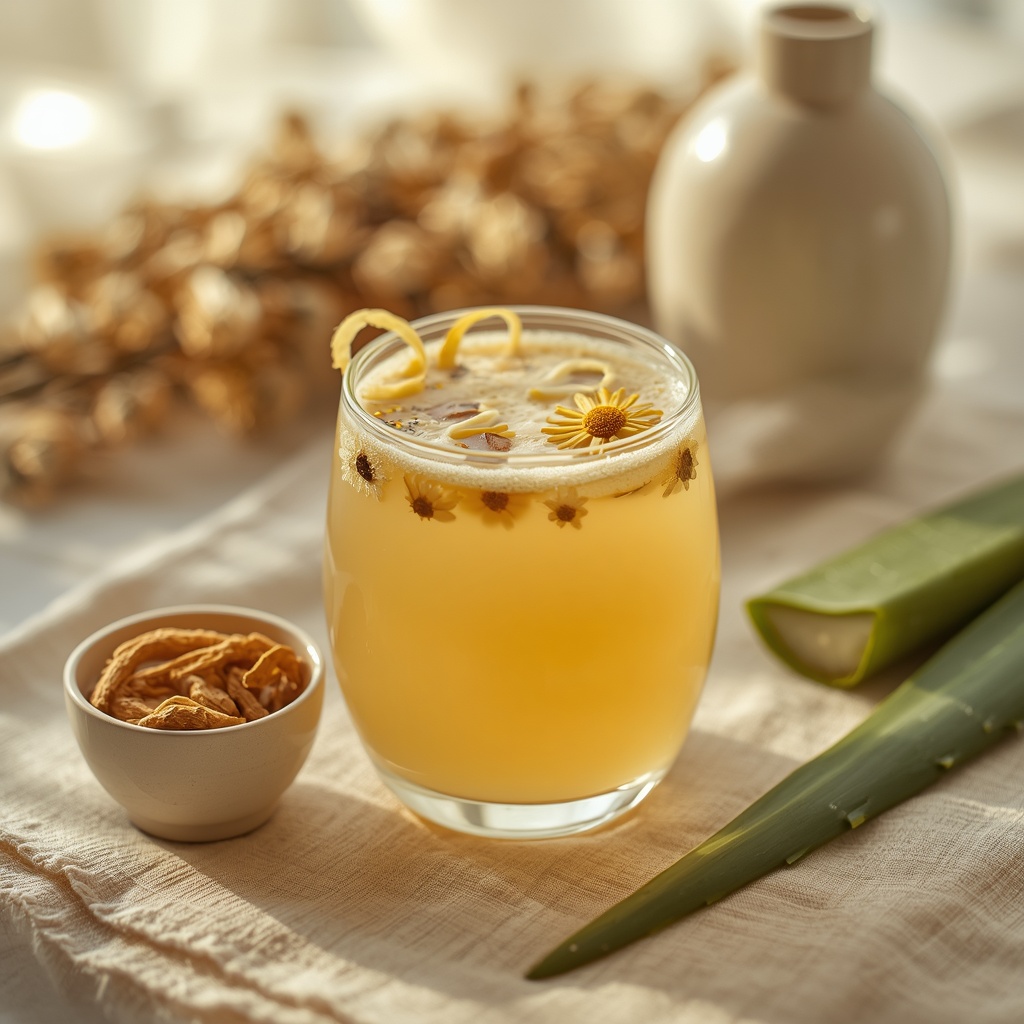
1.Bloom the saffron. Toast saffron threads in a dry ceramic mug over low heat for 10 seconds to release crocin (the heat-activated pigment and primary bioactive). Add 1 tablespoon warm water and allow to bloom for 5 minutes until the infusion turns deep amber-gold.
2.Warm the carrier. In a small saucepan, warm oat milk with the crushed cardamom pod and vanilla seeds over medium-low heat to 60°C (140°F) — visible steam, no boil. Discard the cardamom pod.
3.Combine. Pour the warm spiced oat milk over the bloomed saffron infusion in your mug and whisk gently to combine.
4.Cool and add PEA. Let the mixture cool to 50°C (122°F) — this protects the adaptogenic compounds in ashwagandha and preserves PEA activity. Open the PEA capsule and whisk the micronized powder in thoroughly until fully dispersed. (PEA is fat-soluble and disperses well in oat milk’s lipid matrix.)
5.Add adaptogens and minerals. Add magnesium glycinate powder, ashwagandha KSM-66 (capsule opened or powder), and 2 drops of monk fruit extract if using. Whisk again for 30 seconds until smooth.
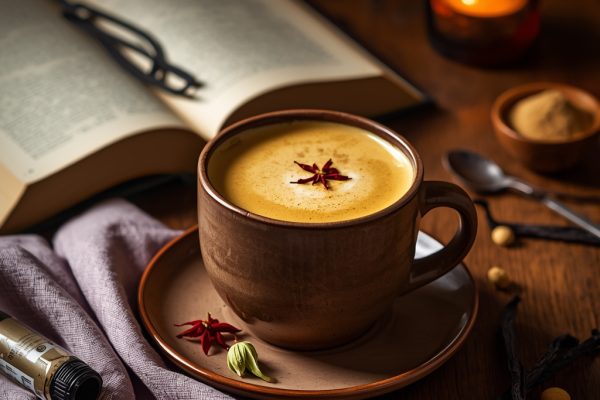
6.Serve and ritual. Pour into your favorite earth-tone ceramic mug. Sip slowly over 15–20 minutes, 60–90 minutes before bed. Light a candle. This is your ritual.
Variations
•Boosted Calm: Add 200 mg L-theanine (capsule opened) at Step 5 for additional GABA-A modulation — the research-backed amino acid that generates calm alertness and deepens sleep quality.
•Sugar-Free: Already zero added sugar. Monk fruit provides sweetness at zero glycemic index.
•Vegan: Already fully vegan — oat milk is the carrier and all supplements are plant-compatible.
•Caffeine-Free: Confirmed. Zero caffeine, zero theobromine. Safe at any hour for the most sensitive nervous systems.
•Budget Version: Substitute ashwagandha with 300 mg holy basil (tulsi) for adaptogenic support at lower cost. Reduce to 6 saffron threads if cost is a concern — clinical effect starts around 15 mg.
Cost estimate: $3.00–$4.50 per serving (premium due to pharmaceutical-grade saffron and micronized PEA). Bulk purchasing reduces cost by 30–40% per serving.
Your Evening Ritual Starts Tonight
Fibromyalgia doesn’t respond to rest days alone. It responds to consistency — to telling your nervous system, night after night, that it’s safe to down-regulate. This latte is designed to be that signal. The saffron’s crocin whispers serotonin. The PEA quiets the glial fire. The magnesium releases the NMDA grip. The ashwagandha walks cortisol back to baseline.
Seven minutes of preparation. Decades of traditional wisdom. Four evidence-based compounds working in concert. Make this your 9 PM anchor.
| Save this recipe to PinterestPin it to your Stress & Anxiety Elixirs board for your next flare evening.#fibromyalgia #saffronlatte #chronicpain #pharmacistapproved #drinkhealer |
Medical Disclaimer
| ⚠ Medical DisclaimerThis article is for informational purposes only and does not constitute medical advice. Always consult a licensed healthcare provider before starting any new supplement regimen.PREGNANCY: Saffron at therapeutic doses is contraindicated in pregnancy (may stimulate uterine contractions). Do not use if pregnant or trying to conceive.BIPOLAR DISORDER: Saffron has mood-activating properties. Consult your psychiatrist before use if you have a bipolar spectrum diagnosis.KIDNEY DISEASE: Magnesium supplementation requires medical supervision in patients with chronic kidney disease.SAFFRON DOSE: Safe upper limit in clinical studies is 30 mg/day. Doses of 100 mg or above are associated with adverse effects and are not recommended without physician supervision. PEA is generally regarded as well-tolerated with an excellent safety profile across RCTs. |