What Persian royalty knew for 3,000 years, clinical pharmacology finally put a number on it.
| ⏱ Prep 10 min | 👥 Serves 1 | 💚 Goal Dopamine & Mood Lift | ⭐ Difficulty Intermediate |
Most of us know that sinking Sunday feeling — flat mood, low motivation, a vague sense of being disconnected from yourself. And most of us reach for the wrong fix: a second coffee that frays the nerves, a handful of sugar that sets off a two-hour crash, or a glass of wine that borrows happiness from tomorrow. Golden Lift is a different answer. Built around saffron, rhodiola rosea, and mucuna pruriens — three botanicals with serious clinical evidence behind them — this warm amber tonic is the kind of mood support your brain actually needs: steady, nourishing, and completely stimulant-free. No adrenal debt. No jitter tax. Just liquid sunshine in a mug.
A Spice That Rivaled Gold — and Still Does
Three thousand years ago in ancient Persia, saffron was so precious it was paid to kings as tribute. Crocus sativus pistils were woven into royal robes, dissolved into bathwater, and stirred into wine not just for their sunset color but for their well-documented effect on the human spirit. Persian court physicians prescribed saffron-infused preparations to alleviate melancholy — what we would today call mild depression. They didn’t have double-blind RCTs. They had centuries of observation.
Fast forward to 2024. A team of researchers at the University of Rennes published a systematic review in the Journal of Integrative Medicine confirming what Persian physicians intuited: saffron’s active compounds — crocin and safranal — inhibit the serotonin transporter (SERT) in the brain, keeping serotonin available longer in synaptic spaces. The mechanism is remarkably similar to that of SSRIs, the most widely prescribed antidepressants in the world. Without the side effects.
Golden Lift pairs saffron with two equally fascinating allies — rhodiola rosea, the Arctic adaptogen that armies of Soviet cosmonauts used to maintain mental sharpness under extreme stress, and mucuna pruriens, a climbing bean from Ayurvedic medicine that supplies L-Dopa, the direct precursor of dopamine, the neurotransmitter of motivation and reward. Together, they address the three neurochemical pillars of mood in one ten-minute ritual.
Why This Tonic Works (According to Science)
Saffron (Crocus sativus — crocin & safranal): The two bioactive compounds in saffron — crocin (responsible for the golden color) and safranal (its aromatic compound) — work by inhibiting the reuptake of serotonin, dopamine, and noradrenaline at synaptic level. In plain terms: they keep these mood-regulating molecules active in your brain for longer. A meta-analysis published in the Journal of Integrative Medicinefound saffron supplementation (30 mg/day) produced a large effect size vs. placebo (ES = 1.62, p < 0.001) in adults with Major Depressive Disorder — comparable to antidepressant medication with significantly fewer side effects.
Rhodiola rosea + Saffron (the combination): A 2025 double-blind, placebo-controlled RCT published in European Psychiatry (PMC12437972) tested the rhodiola + saffron combination in 126 adults with moderate depression. The supplemented group showed a 10-point decrease in HAM-D depression scores at Day 21 vs. placebo (p = 0.005) — a clinically meaningful improvement in less than three weeks. The remission rate (HAM-D ≤ 7, “no depression”) was significantly higher in the supplement group.
Mucuna pruriens (natural L-Dopa — the dopamine angle): Mucuna seeds contain L-Dopa, the direct metabolic precursor of dopamine, which crosses the blood-brain barrier via the L-amino acid transport system. A study published in Ayu Journal (PMC4213977) demonstrated antidepressant activity comparable to imipramine (a tricyclic antidepressant) via the dopaminergic system — shown by significant reduction in immobility time in forced swim and tail suspension tests, reversed by dopamine antagonists. The 2024 review in Neurology International (PMC11587415) confirmed these findings across multiple animal models.
Turmeric + Black Pepper (BDNF amplification): Curcumin stimulates the production of BDNF (Brain-Derived Neurotrophic Factor), a protein closely linked to reduced anhedonia (the inability to feel pleasure). The pinch of black pepper is not optional: piperine increases curcumin’s bioavailability by up to 2,000%, transforming what would otherwise pass through your gut into a genuinely active compound.
| 💡 Did You Know?The clinical dose of saffron used in antidepressant trials is 30 mg/day — the exact amount in this recipe. That’s 5–6 pistils or one standardized extract capsule dissolved in your tonic. Persian physicians were, unknowingly, hitting the therapeutic dose almost perfectly. |
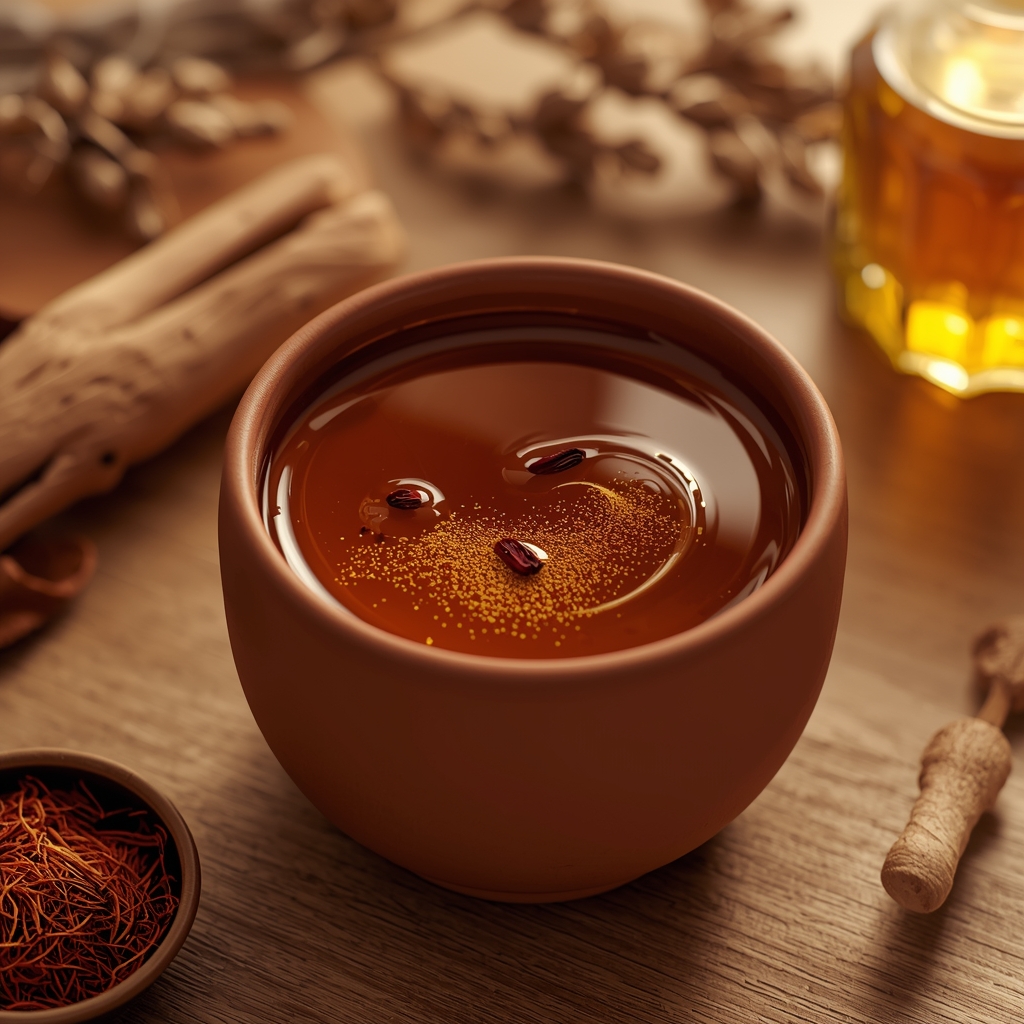
Recipe: Golden Lift — The Dopamine Sunrise Tonic
Ingredients
| Ingredient | Amount | Health Role | Where to Find |
| Saffron extract (Affron® or pistils) | 30 mg extract / 5–6 pistils infused | Serotonin reuptake modulation, dopamine support, neuroprotection | Amazon (Zazzee, Carlyle), Whole Foods |
| Rhodiola rosea extract (3% rosavins) | ½ tsp (≈ 200 mg) | HPA axis balance, anti-fatigue, mood stabilization under stress | Amazon (Gaia Herbs, NOW Foods) |
| Mucuna pruriens extract (15% L-Dopa) | ¼ tsp (≈ 100 mg) | Dopamine precursor (L-Dopa), motivation, anhedonia support | Amazon (Himalaya, Double Wood Supplements) |
| Warm unsweetened almond milk | 8 oz (240 ml) | Dairy-free base, vitamin E, neutral flavor | Walmart, Whole Foods |
| Ground turmeric | ¼ tsp | Anti-inflammatory, BDNF support, warm flavor | Any grocery store |
| Black pepper | 1 pinch | Piperine: increases curcumin bioavailability ~2,000% | Any grocery store |
| Raw honey | 1–2 tsp | Natural sweetener, prebiotic oligosaccharides for gut-brain axis | Walmart, Whole Foods |
| 💰 Estimated budget: $10–15/week | ✅ Zero white sugar | ✅ Zero high caffeine | ✅ 100% mood-supportive without stimulant spikes |
Instructions (5 Steps)
1. Step 1 — Infuse the saffron: Steep 5–6 pistils in 2 tbsp warm water for 5 minutes to release crocin and safranal. (If using extract powder, dissolve directly in warm water.) The water should turn deep amber. 💡 Time-saver tip: Pre-infuse saffron the night before in a small sealed container in the fridge — color concentrates and flavor deepens overnight.
2. Step 2 — Heat the milk: Warm almond milk to 65–70°C (just below simmer). Never boil — excessive heat degrades the rhodiola compounds.
3. Step 3 — Dissolve the adaptogens: In a small bowl or directly in the mug, whisk rhodiola and mucuna powders with a few tablespoons of warm milk until fully dissolved, with no visible lumps.
4. Step 4 — Combine and blend: Pour the warm milk into the mug with the saffron infusion. Add turmeric, black pepper, the dissolved powder blend, and honey. Whisk vigorously for 20 seconds — or use a frother or blender for a silkier texture. The color should be deep gold to amber.
5. Step 5 — Garnish and serve: Pour into a warm ceramic mug immediately. Lay 2–3 saffron pistils on the surface and trace a spiral of turmeric on top. Serve as a morning or afternoon ritual — not recommended within 3 hours of bedtime due to rhodiola’s mild stimulant effect.
Variations
| 🌿 Sugar-free | Replace honey with 2–3 drops of liquid monk fruit — zero glycemic impact. |
| 🥛 Strictly vegan | Substitute honey with pure maple syrup. |
| ❄️ Iced version | Prepare hot, let cool completely, serve over ice. |
| 💪 Boosted version | Add ¼ tsp lion’s mane + ½ tsp raw cacao powder (theobromine + PEA for mood, no high-caffeine spike). |
Your Mood Deserves Better Than a Coffee Spike
Try Golden Lift as a Sunday afternoon ritual — or any time you feel flat and need your brain to come back online without borrowing energy from tomorrow. Three botanicals, ten minutes, one mug. Your neurochemistry will feel the difference.
| 📌 Save this recipe on Pinterest for later!👉 You might also love: Lion’s Mane Focus Latte — The Brain Fog Eraser (Mind & Mood)💌 Get 1 new science-backed healthy drink recipe every week — Join the DrinkHealer newsletter |
| ⚠️ Medical DisclaimerThis article is for informational and general wellness purposes only. It does NOT constitute medical advice and is NOT intended to diagnose, treat, cure, or prevent any disease or mental health condition. Mucuna pruriens contains L-Dopa — use with caution if you take MAO inhibitors, antidepressants, or Parkinson’s medications; consult your physician before use. Saffron at doses above 30 mg/day is not recommended during pregnancy. This recipe is NOT a substitute for professional mental health treatment. If you experience symptoms of depression, please seek qualified medical care. |